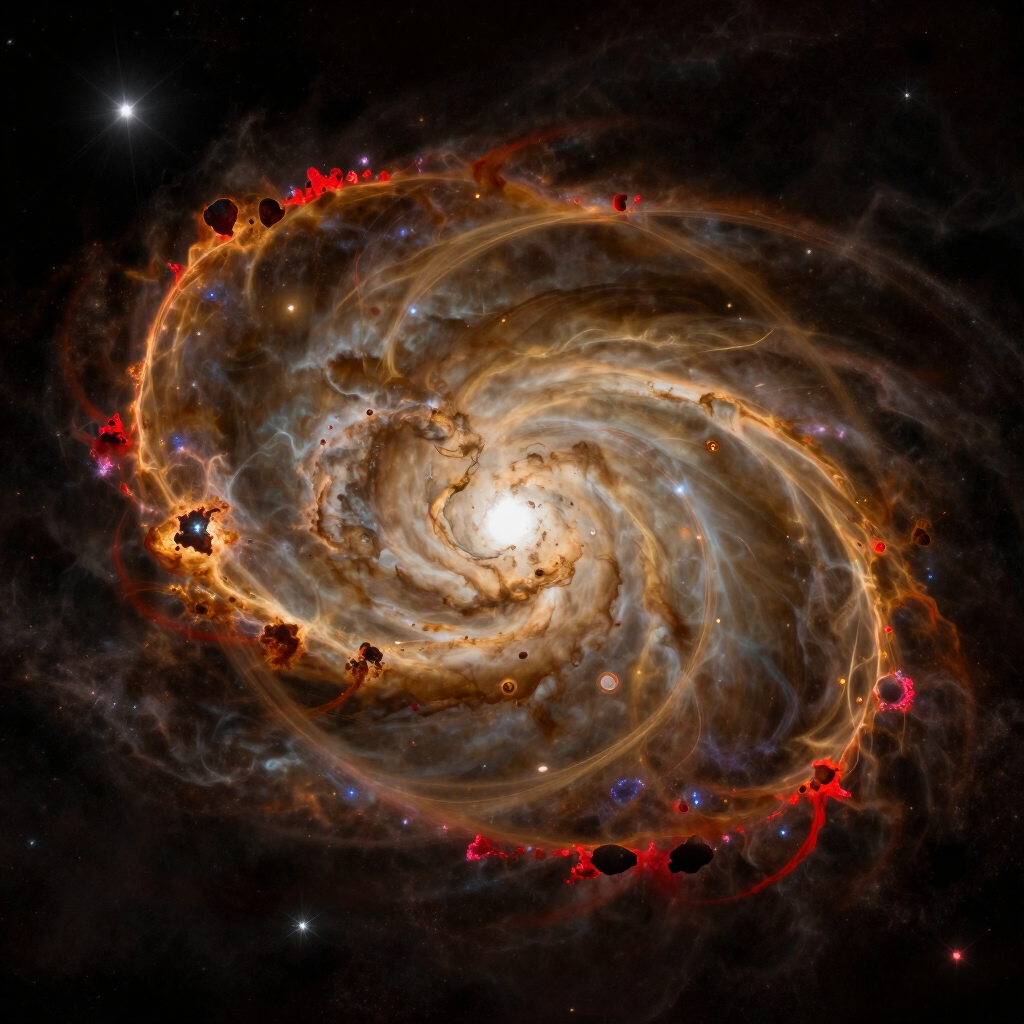
A Window Into the Universe's First Light
The James Webb Space Telescope has confirmed galaxies that formed just 300 million years after the Big Bang — among the earliest structures ever observed. These findings, refined through August 2026, push the boundary of the observable universe deeper into the so-called cosmic dawn.
Because light takes time to travel, looking far away means looking back in time. The faint infrared glow Webb collects from these galaxies began its journey over 13.4 billion years ago, when the universe was a fraction of its current age.
How Webb Sees the Unseeable
Webb's infrared instruments pierce through the cosmic dust that blocks ordinary visible-light telescopes. As the universe expands, ancient light is stretched — redshifted — from visible into infrared wavelengths, exactly where Webb is designed to see.
Gravitational lensing, where massive galaxy clusters bend and magnify the light of distant objects behind them, acts as a natural telescope, allowing Webb to resolve galaxies that would otherwise be too faint to detect.
Why These Galaxies Are Surprising
The newly confirmed galaxies appear far more massive and structured than standard cosmological models predicted for such an early epoch. Their rapid assembly suggests that the first stars and galaxies formed faster — and through more efficient processes — than scientists previously believed.
This challenges existing theories of galaxy formation and may reshape our understanding of how matter coalesced in the early universe.
The Search for the First Stars
Webb's next frontier is identifying Population III stars — the very first generation of stars, forged from pristine hydrogen and helium. These stars have never been directly observed, and confirming them would close a major gap in our cosmic origin story.
Key Takeaways
- Webb confirmed galaxies from 300 million years after the Big Bang
- Infrared vision reveals light stretched across 13.4 billion years
- Gravitational lensing magnifies the faintest early galaxies
- Galaxies formed faster than standard models predicted
- Next goal: detecting the universe's first stars