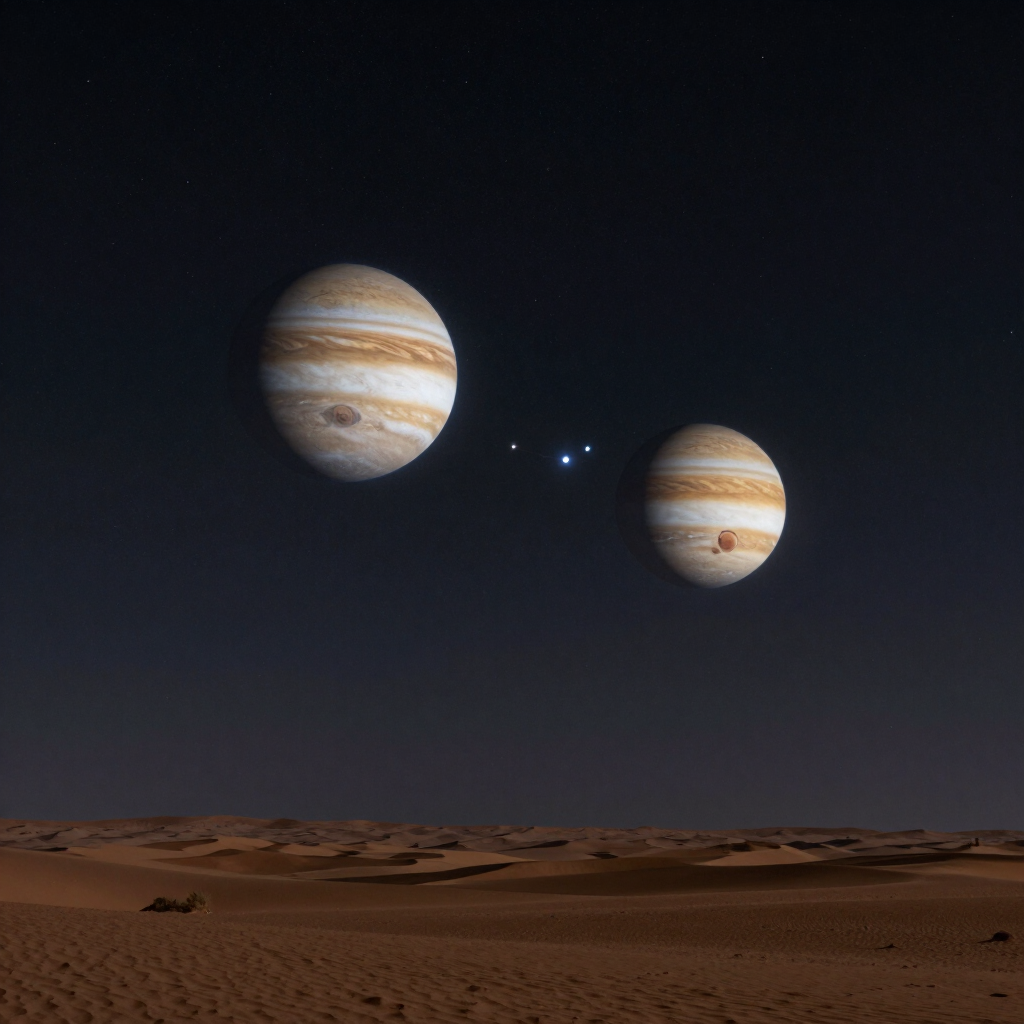
Two Worlds Pass in the Night
On the morning of August 8, 2026, Mars and Jupiter will appear remarkably close together in the predawn sky in a beautiful planetary conjunction. The two worlds will sit within a fraction of a degree of each other, close enough to share a single field of view in a small telescope.
A conjunction is a line-of-sight alignment — the planets are not actually near each other in space, but they appear side by side from our vantage point on Earth. The result is a striking visual pairing of two of the sky's brightest objects.
When and Where to Look
Look to the eastern sky in the hour before dawn, roughly 4:00-5:30 AM local time. Jupiter will blaze as the brighter of the two, a brilliant white-yellow beacon, while ruddy Mars glows with its distinctive orange-red hue just beside it.
The pairing is visible to the naked eye, but binoculars or a small telescope will reveal Jupiter's four Galilean moons and Mars's tiny ruddy disk in the same view — a memorable sight.
What Makes a Conjunction Special
Because the planets orbit the Sun at different speeds, close conjunctions between any given pair are relatively rare. A Mars-Jupiter pairing this tight will not recur for years, making August 8 a date worth setting an early alarm for.
The best views come from a location with a clear eastern horizon, away from buildings and bright lights.
Photographing the Pairing
A long lens on a tripod can capture both planets in a single frame. For a wider composition, include the dawn horizon to convey the scale and beauty of the moment. A short exposure keeps the planets sharp while a longer one reveals Jupiter's moons.
Key Takeaways
- Conjunction date: August 8, 2026, before dawn
- Look east between 4:00 and 5:30 AM local time
- Jupiter is bright white-yellow; Mars is orange-red
- Visible to the naked eye, stunning in binoculars
- A telescope may show Jupiter's moons and Mars together