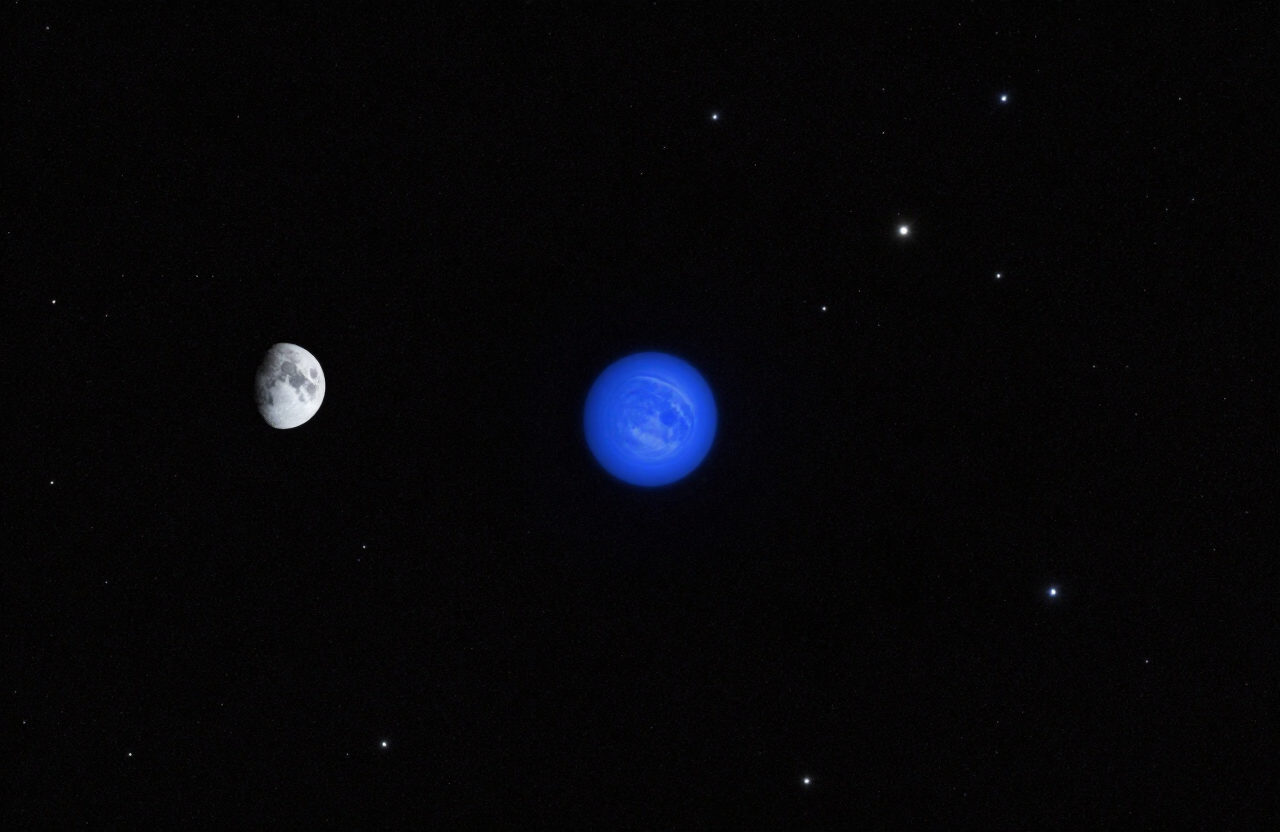
The Farthest Planet at Its Best
Neptune, the most distant of the eight planets, reaches opposition in September 2026 — the one time each year when it sits opposite the Sun in our sky, rising at sunset and setting at sunrise. For a few weeks around opposition, Neptune is at its closest, largest, and brightest, offering the best window to track down this remote blue world.
Even at opposition, though, Neptune is a challenge. At roughly 4.3 billion kilometers from the Sun, it never gets brighter than magnitude 7.8 — just below the naked-eye limit — so you will always need binoculars or a telescope to see it.
What Opposition Means for Neptune
Neptune takes about 165 Earth years to orbit the Sun once, the longest year of any planet. Because it crawls so slowly across the sky, it reaches opposition only about two days later each year. At opposition, Earth sits directly between Neptune and the Sun, placing the ice giant fully illuminated from our viewpoint and visible all night long.
This year Neptune lies in the constellation Pisces, drifting slowly westward against the background stars in retrograde motion — a handy way to confirm you have found it over consecutive nights.
How to Find Neptune
Start with a good star chart or astronomy app set to the opposition date. Neptune sits among the faint stars of Pisces, well above the horizon at midnight. In 10x50 binoculars it appears as a tiny, steady blue-gray dot that does not twinkle. In a telescope at 100x or more, its small disc resolves into a distinctly blue hue — the signature of methane in its atmosphere absorbing red light.
Look for it high in the southern sky (from the northern hemisphere) around midnight, when it is highest and least distorted by our atmosphere.
Why Neptune Is So Extreme
Neptune is a true ice giant — a world of water, ammonia, and methane ices wrapped around a rocky core. It hosts the fastest winds in the solar system, screaming at over 2,000 kilometers per hour, and a Great Dark Spot storm system discovered by Voyager 2 in 1989. Its largest moon, Triton, orbits backward — a captured Kuiper Belt object that likely once orbited the Sun on its own.
Despite being farther from the Sun than Uranus, Neptune radiates more heat than it receives, a mystery that still puzzles planetary scientists.
Key Takeaways
- Neptune reaches opposition in September 2026 — visible all night
- At magnitude 7.8, it always needs binoculars or a telescope
- Found in Pisces; a small blue disc at 100x or more
- Hosts the fastest winds in the solar system, over 2,000 km/h
- Its moon Triton is a captured Kuiper Belt object orbiting backward