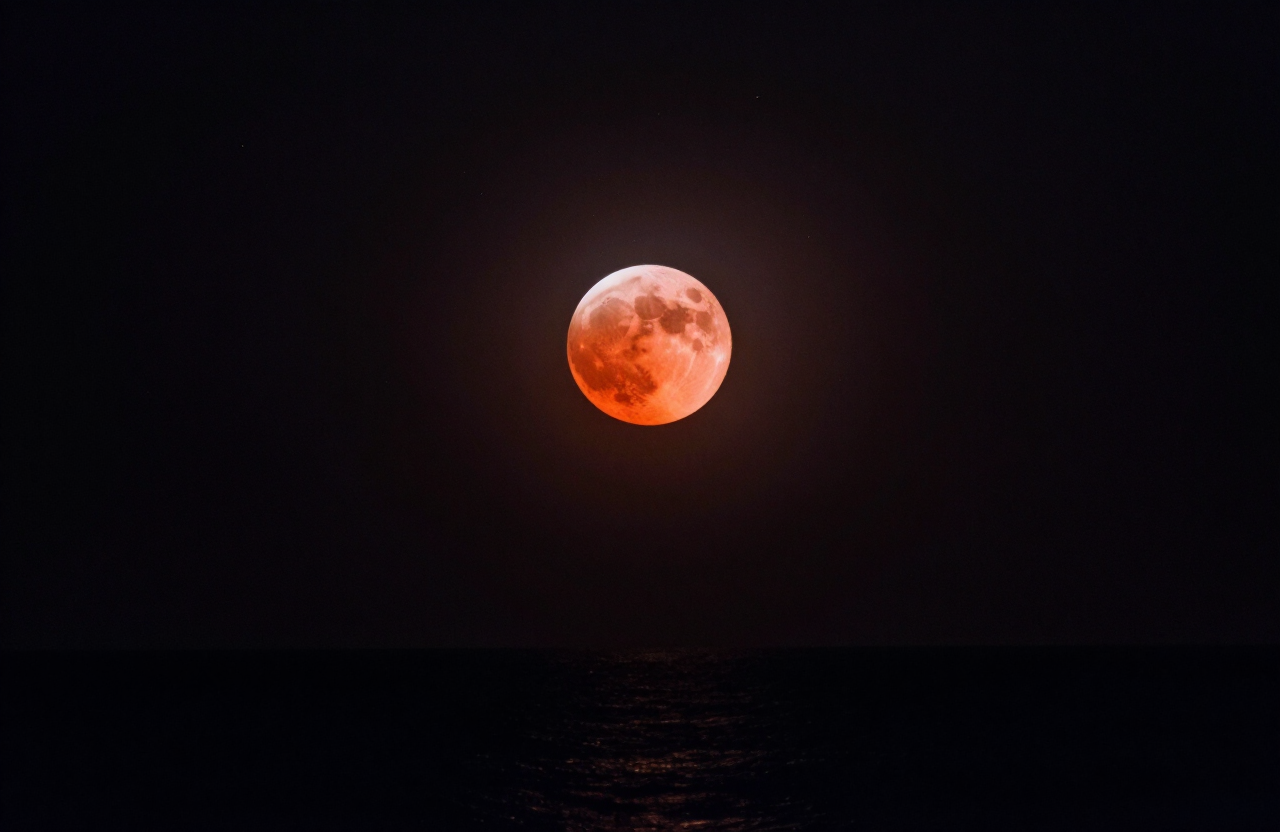
The Moon Turns to Blood
On September 7, 2026, the Moon slips entirely into Earth's shadow and glows a deep, eerie red in a total lunar eclipse — the first total eclipse of the Moon since March 2025. For over an hour, our nearest neighbor will hang in the sky painted in copper and crimson, a sight humans have marveled at and feared for millennia.
Unlike a solar eclipse, a lunar eclipse is safe to view with the naked eye and lasts long enough to enjoy without rushing. No filters, no urgency — just a dark sky, a patient eye, and one of nature's most dramatic light shows.
What Causes a Blood Moon?
A total lunar eclipse happens when the Sun, Earth, and Moon line up perfectly, with Earth in the middle. The Moon passes through Earth's umbra — the darkest part of our planet's shadow — and direct sunlight is blocked from reaching it.
Yet the Moon does not vanish. Earth's atmosphere bends sunlight around the planet's edge, scattering out the shorter blue wavelengths and letting only the longer reds and oranges through. That reddened light spills onto the Moon's face, the same physics that paints our sunrises and sunsets. The more dust and aerosols in our atmosphere — from volcanoes or wildfires — the deeper and darker the red.
Where and When to Watch
The September 7, 2026 total lunar eclipse is visible from much of Asia, Australia, the Pacific, and parts of Africa and Europe. The Moon enters the faint outer shadow (penumbra) first, then the partial phase begins as it crosses into the umbra. Totality — the fully red phase — lasts roughly 70 minutes, with the entire event spanning several hours.
Check a local eclipse map for exact timing at your location, since the Moon must be above your horizon during the eclipse for you to see it. Unlike solar eclipses, no eye protection is needed.
How to Photograph the Blood Moon
A tripod is essential — the dim red Moon demands longer exposures that you cannot hand-hold. Use a telephoto lens (300mm or longer) to fill the frame, keep ISO moderate (400–800), and bracket your exposures because the Moon's brightness changes dramatically between partial and total phases. During totality, increase exposure to capture the rich reds; during the partial phase, shorten it to keep the sunlit edge from blowing out.
Key Takeaways
- Total lunar eclipse on September 7, 2026 — the Moon glows blood-red
- Earth's atmosphere filters sunlight, letting only red light reach the Moon
- Visible from Asia, Australia, the Pacific, and parts of Africa and Europe
- Totality lasts about 70 minutes; safe to view with the naked eye
- A tripod and telephoto lens capture the best photos